
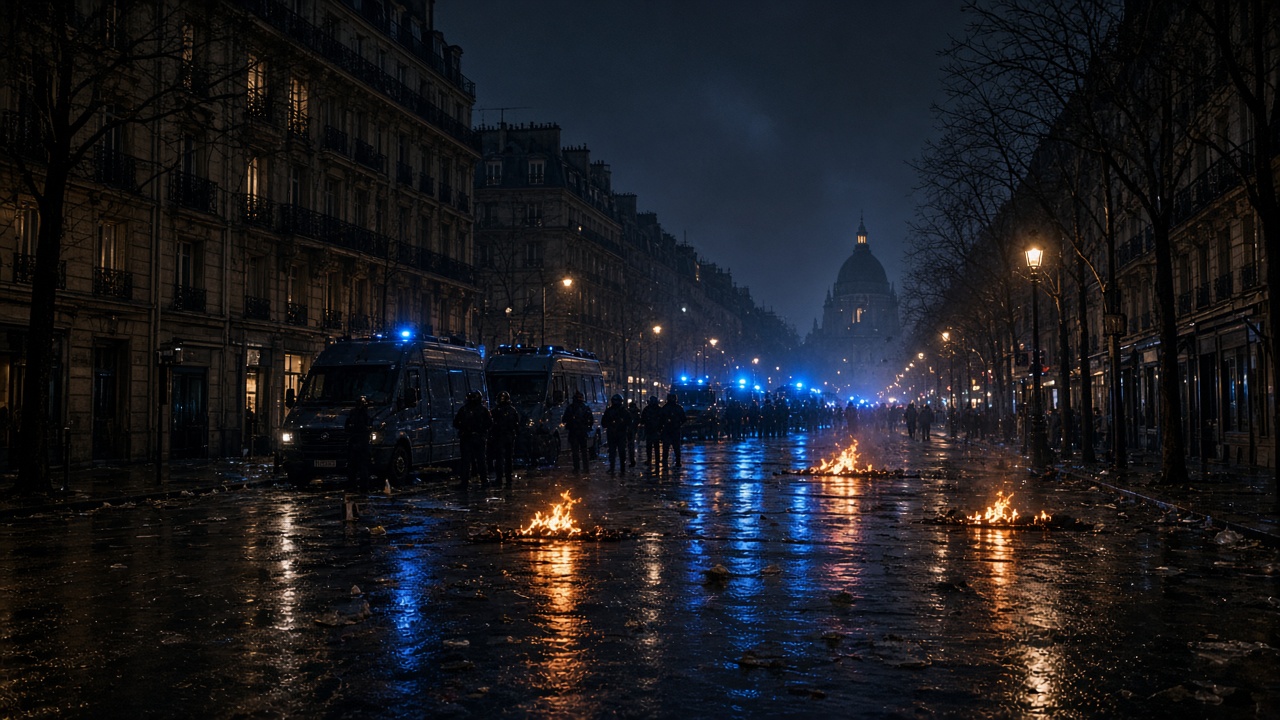
PARIS - The worst street violence France has seen in years rolled into a third day on Monday, and the government's answer is the curfew. After a crisis meeting, Prime Minister Sébastien Lecornu instructed the authorities to impose locally limited curfews to stop the looting that has scarred Paris and several other cities since the weekend.
The numbers tell their own story: 351 arrests in the capital on Sunday and the following night alone. President Emmanuel Macron, speaking on Sunday evening as the looting continued, demanded an investigation into possible failures in the police response, while firmly refusing the resignation of Interior Minister Laurent Nuñez. The Yellow Vests, never far from the surface of French street politics, have announced fresh demonstrations for the coming Saturday. Italy, too, saw outbreaks of unrest over the weekend.
A Swiss contingent in the Paris crowds
The French crisis has a Swiss footnote that is quickly becoming a story of its own. Swiss activist groups took part in the demonstrations in France, among them Julien Berthod, a vice-president of the Young Socialists. Back home, organisers are now promoting a youth strike in several Swiss cities on 20 November, explicitly framed as an import of the French moment.
That prospect will concentrate minds in Bern and Zurich, where the anniversary of last autumn's riots is still fresh. Around 1,000 people joined an unauthorised anti-capitalism rally in Bern only days ago, and Zurich police are still investigating the night when a masked crowd attacked officers with stones and fireworks after an illegal party. A called strike with a fixed date gives authorities something those events did not: time to prepare.
Watching the neighbour's house
For Switzerland, France is the neighbour whose moods travel. The two countries share a language region, a border workforce and a habit of reading each other's protest cultures. What happens on the boulevards of Paris tends to echo in Lausanne and Geneva first, and the announced 20 November strike suggests the echo this time is organised rather than spontaneous.
Whether curfews calm the French streets or simply move the crowds will be clear by the weekend. What is already clear is that the autumn's protest season, which has so far touched Switzerland only at the edges, with peaceful marches like the thousand-strong Gaza demonstration on Bahnhofstrasse, now has a date on the calendar and a template from across the border.