
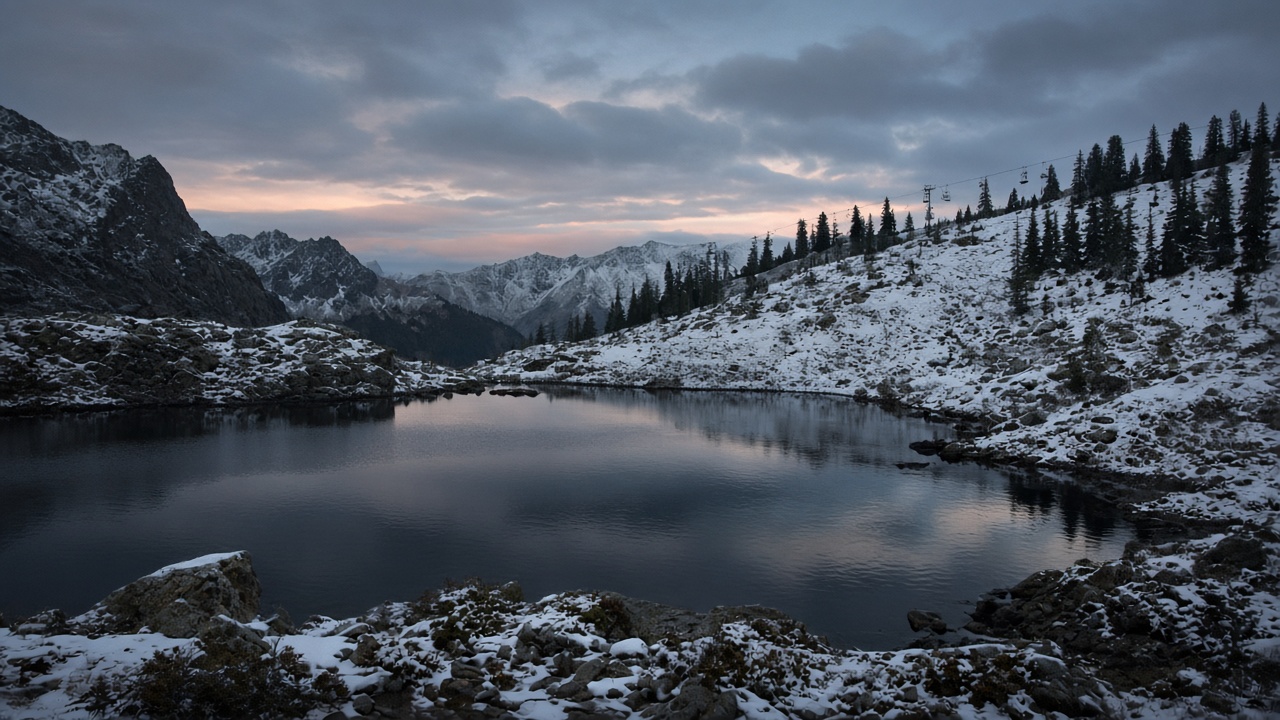
BERN - Swiss ski areas say they have enough water to make snow, despite a dry and hot summer. In a Keystone-SDA survey published on Monday, 23 November, the large mountain railways said their storage lakes are well filled. Fears that the drought would delay the season have not, on those accounts, come true.
Bernese Oberland and Graubünden
Kathrin Naegeli, head of corporate communications for the Jungfrau Ski Region, said the mountains had more thunderstorms than the lowlands, and that rain and snow had fallen recently. Clear, cold nights without fog have left the ground cooler than in other years. She said the altitude, between 1,800 and 2,500 metres, gives the region reliable snow, and that weather, wind and humidity matter more than the summer drought once snowmaking starts in November.
At Meiringen-Hasliberg, marketing and sales lead Simon Schmid said the snowmaking lake is full. From today's vantage point, nothing blocks a continuous opening from 19 December. The ground is not warmer than usual, and choosing which pistes to cover first is already standard practice.
In Graubünden, Corviglia above St Moritz stores its water at 2,500 metres or higher in two natural reservoirs. A spokesperson said the lakes use only meltwater and rain, so groundwater and drinking water are not touched, and that precipitation in the Upper Engadin was around the average. In the Lower Engadin, Scuol Bergbahn director Andri Poo said he is confident about a 12 December opening. The reservoirs are full and groundwater is not being used. At San Bernardino, Nicolò Meroni of San Bernardino Swiss Alps said there is enough water for Pian Cales, the only piste the resort covers with machines.
Central Switzerland, Valais and the west
Hoch-Ybrig chief executive Urs Keller said the storage lake is completely full, with enough water for snowmaking and for drinking water. He does not expect the season start to move. Stefan Ryser, director of Sörenberg, the largest ski area in canton Lucerne, does not expect a shorter winter or an early close. The area draws on three linked sources: the Eisee, the Schwand reservoir and the Waldemme. The Eisee is slightly below its usual level, but Ryser still expects the holiday period to be covered.
Titlis, above 3,000 metres and facing north, is treated by its operators as one of the more snow-sure areas. Communications lead Fabian Appenzeller said the Trübsee, from which the railway takes a contractually fixed volume of water, is well filled, and that no extra snow is needed at the moment.
In western Switzerland, Télé-Villars-Gryon-Diablerets takes water from a reservoir of 45,000 cubic metres that was filled with meltwater in spring, sales director Félicien Rey-Bellet said. The spring that feeds the lake is down only about 10 percent. Dry ground also cools faster in a frost than wet ground, which helps the snow guns. In Valais, Téléverbier marketing lead Alain Michellod said the drought has reduced reserves and that the resort needs careful water management. The Gotthard Pass road is already on its winter closure, a separate Alpine calendar from the question of whether the reservoirs can feed the guns.