
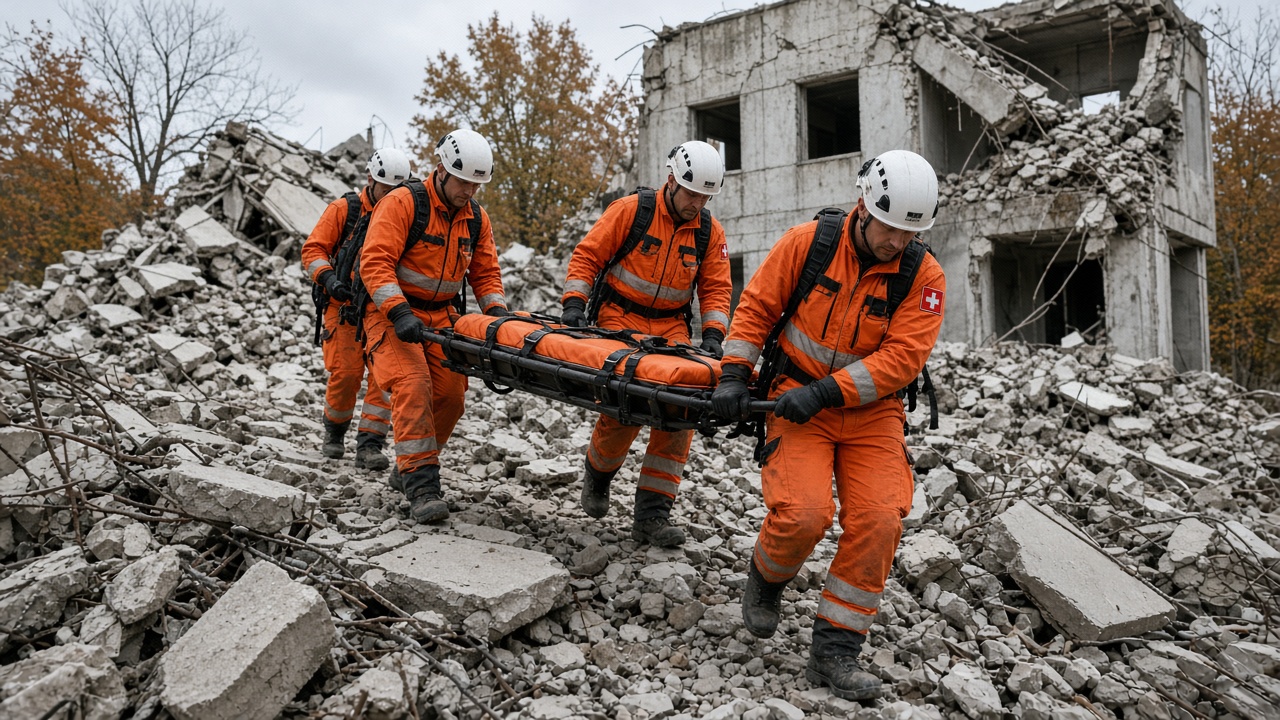
GENEVA - Around 500 participants, roughly half of them from abroad, spent four days this week training for the aftermath of a severe earthquake in western Switzerland. The exercise, EU MODEX Switzerland 2026, ran from Monday to Friday at the Epeisses training village in canton Geneva, in the city of Geneva and at the military airfield in Payerne. It was the first time Switzerland hosted an international civil protection exercise within the European Union's Civil Protection Mechanism, the Federal Office for Civil Protection said on Friday.
The scenario was a strong earthquake causing very severe damage across the cantons of Geneva, Vaud and Fribourg. Under the script, the cantonal authorities and the National Alarm Centre asked the Federal Council to request international help through the EU mechanism, which then mobilised rescue modules and further resources from several countries, whose teams travelled to Switzerland to join the operation.
Interoperability as the goal
The purpose of the drill was to test how foreign rescue modules work inside a host country: who coordinates, where teams land, and how they are housed, fed and moved between sites. Switzerland ran the coordination between the authorities and the logistics. The Federal Office for Civil Protection said cooperation between its own staff, the cantons of Geneva and Vaud and the other federal agencies involved worked flawlessly.
Officials also drew a line from the exercise to real events. After the deadly Crans-Montana fire in January, the same European mechanism helped Switzerland move dozens of patients to specialised hospitals abroad, a transfer federal officials credit with saving lives. The lesson that disasters do not respect borders has landed in a year when parliament is also arguing over the money for domestic security, from the CHF 24 billion defence fund to cyber protection.
A Swiss place in a European system
Switzerland takes part in the Civil Protection Mechanism as a non-EU participating state, one of the quieter strands of the bilateral relationship that dominated the autumn session. Hosting a MODEX is both a stress test and a statement: Geneva once again becomes a city where international machinery is not just debated but switched on, much as it will be for the planned AI summit at Palexpo next June.
The exercise closed on Friday. A full evaluation follows, and the participating teams go home with what the organisers call valuable experience in working together, the kind that only shows its worth on the day it is needed.