
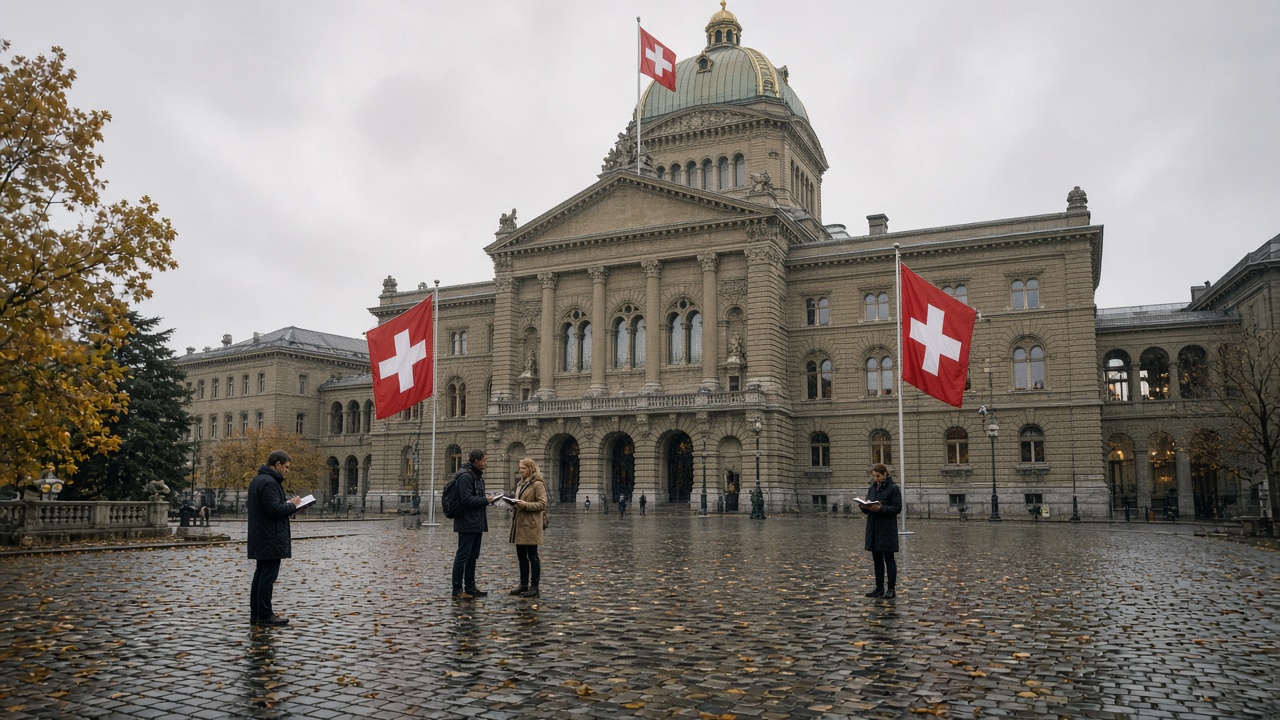
BERN - The Council of States spent Tuesday on the detail of the Switzerland-EU treaty package, a day after it voted to take the file up at all. Monday's entry vote was 29 to 15. The upper house has scheduled the detailed reading to run through Wednesday.
The package, often called Bilaterals III, was negotiated between Bern and Brussels from March to December 2024. It covers 94 EU legal acts, 18 agreements and protocols, and two joint declarations. Most of the agreements were signed in Brussels on 2 March 2026 by President Guy Parmelin and European Commission President Ursula von der Leyen. Parliament cannot rewrite the treaty text. It can decide whether to approve it, how Switzerland applies it at home, and what kind of referendum follows.
What is still open in the EU treaty debate
Wage protection, the referendum rule, immigration, dynamic adoption of EU law, state aid, and education and research are the points senators have flagged as contested. The electricity agreement is still in committee and is not part of these three days. Carlo Sommaruga, the Geneva Social Democrat who chairs the foreign affairs committee, has called the referendum choice decisive: a simple majority of the people, or a double majority of people and cantons.
The Federal Council, the Social Democrats, the FDP and the Green Liberals have backed an optional referendum with a simple majority, the path used for Bilaterals I and II. The Swiss People's Party wants a mandatory referendum and a double majority. The Centre has said it will settle its line as the debate goes on. Two constitutional affairs committees favoured the double majority. The two foreign affairs committees did not. A plain-language map of those three arguments is in our 11 September briefing.
Why Monday's vote still matters on Tuesday
Only the seven-member SVP group voted as a bloc against entry on Monday, joined by four German-speaking members of the Centre and four from the FDP. The Social Democrats, the Greens, the Green Liberal representative and most of the Centre and FDP voted to proceed. President Stefan Engler had asked for short speeches after 111 hours of committee work across 39 days. Three federal councillors sat through that opening day: Parmelin, Foreign Minister Ignazio Cassis and Justice Minister Beat Jans. The full split is in Monday's report.
The European Parliament's lead committee approved the package by a large majority two weeks ago. A plenary vote in Brussels is expected before the end of the year. In Bern, the Federal Assembly is not expected to finish before 2027, and one to four referendums are likely once both chambers are done. Cassis said on Sunday he would not read the neutrality result as a forecast for this file.