
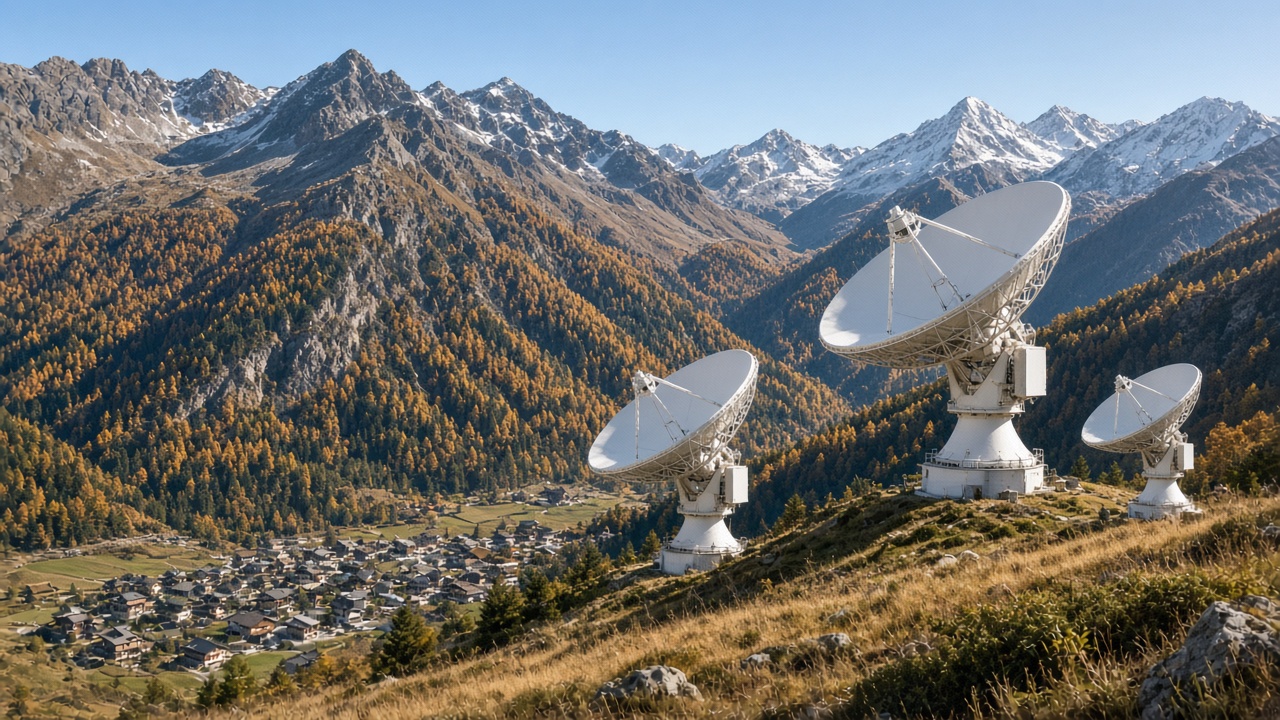
BERN - The resistance to Elon Musk's plans in Valais has reached the federal parliament. SP national councillor Fabian Molina has filed a motion demanding that no Starlink ground station be built in Switzerland at all, co-signed, in a pairing almost never seen in Bern, by the SVP national councillors Walter Gartmann and Jean-Luc Addor.
SpaceX plans to erect 40 antennas on the Brentjong plateau above Leuk. They would serve as gateways between the conventional internet and the roughly 11,000 Starlink satellites in orbit, making the Valais site one of the largest stations of its kind in Europe, even though Starlink already works in Switzerland without it. The municipal council of Leuk granted the building permit at the end of November 2025, with mayor Alain Bregy hoping for economic stimulus and extra tax revenue. An appeal by residents, among them the association Schutz vor Satellitenstrahlung Region Leuk, is pending before the Valais State Council. The objectors cite radiation, power consumption, light pollution, data protection and security policy.
The neutrality question
Molina is not the first to move. SP national councillor Jacqueline Badran has demanded since March that the Confederation neither extend Starlink's existing trial licence nor grant a definitive radio concession, calling the network a geopolitical and power-political risk. Her supporters include former Centre president Gerhard Pfister, the FDP's Andri Silberschmidt and the Green Liberals' Kathrin Bertschy. Centre senator Fabio Regazzi has separately asked the Federal Council how such a station can be reconciled with Swiss neutrality.
The sceptics' argument has sharpened with the wars of the decade. Starlink is no longer only a civilian internet service: it plays a central role in the war in Ukraine, has been used by the United States in its conflict with Iran, and its availability has become an instrument of American power. Musk threatened in 2022 to cut Ukraine off, and since February 2026 his company has denied Russia access, to Moscow's visible disadvantage. The Federal Council rejects the neutrality reading: Starlink, it holds, is operated by a private company, and private operation does not violate Swiss neutrality. One SVP councillor has also cautioned that a radio licence cannot be refused on geopolitical grounds alone if the legal conditions are met.
Two fronts, one outcome pending
The project's future is now contested on two tracks: legally in Sion, where the State Council must rule on the residents' appeal, and politically in Bern, where the motions will land in committees after the winter session opens. For a parliament that just spent three weeks arguing about how tightly to bind Switzerland to its neighbours, the question of how much of Elon Musk's infrastructure belongs on an Alpine meadow is proving an unexpectedly natural sequel.