
BERN - A few degrees on a temperature chart are enough to unsettle the European gas market. Traders had been pricing a mild winter. Marco Saalfrank, head of international trading at Axpo, now says November could be one of the coldest in the past ten years. A cold snap of that kind would lift gas demand across the continent, and the stores meant to cover it are thinner than usual.
Gas prices are close to autumn 2022
At the start of October, gas for delivery the following month cost about 72 euros per megawatt hour. It later climbed above 100 euros. That is short of the records, and only a little under the crisis prices of autumn 2022. Swiss power for delivery in 2027 has also jumped, by 13 percent in two weeks on the futures market. Oil has been rising at the same time, which adds to the nerves.
The last tight winter had a different cause. After the invasion of Ukraine, most Russian pipeline gas to Europe stopped, and about half of France's nuclear fleet was offline for a time. Switzerland scraped through because the winter was unusually warm. This time the pressure is a stack of smaller problems. The war in Iran pushed gas prices up in the summer, so energy firms held back when they would normally have filled storage. In north-western Europe, gas stores now sit about 23 percentage points below the long-run average. That matters for electricity: the EU still generates about a sixth of its power with gas.
Reservoirs are at a record low for late October
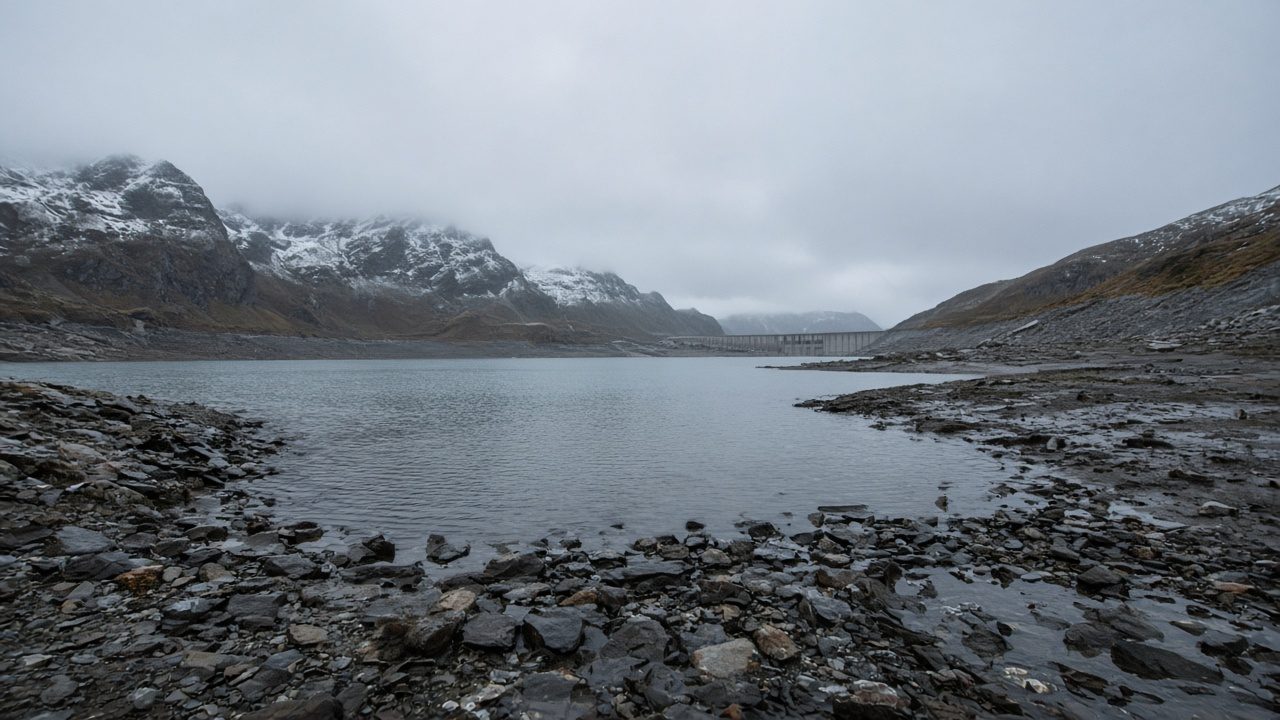
Switzerland's own cushion is water, and the water is low. The long dry spell left the reservoirs short, and the heavier rain of recent weeks has not closed the gap. On 26 October the federal energy dashboard showed the lakes at 70 percent. The average for that date over the past ten years is 84 percent. It is the lowest late-October reading since the series began in 1997. The drought that left farms and forests short of water through the autumn is the same deficit now showing up in the power system. The federal heat and drought plan adopted last week treats that pattern as a standing risk, not a one-off season.
Axpo chief Christoph Brand wrote on LinkedIn last week that he saw no reason for panic, and no reason for complete ease either. If large plants stay online, he does not expect a supply gap. If conditions turn against the system, he said, coal plants in the EU would likely be started up and Switzerland would need much more imported power. What he would promise is that the winter will be expensive.
Elcom will not rule out a shortfall
The Federal Electricity Commission (Elcom) is no more reassuring. Spokeswoman Antonia Adam said a supply shortfall this winter cannot be excluded. The dangerous case is several risks at once: tight gas, unexpectedly weak nuclear and wind output, a long cold spell, and a drought that does not break.
The lakes are not only low. Current prices pay more for power next month than for power later in the winter, so operators have a reason to run the water early rather than save it. Elcom still rates the risk of a physical power shortage as low. Adam said the higher prices do not, on their own, point to a real scarcity of supply. French and Swiss nuclear plants are available, which helps. The open question is whether neighbours will have power left to export if their own gas-fired output is constrained.
Bern bought an option on the Transitgas pipeline
The federal supply office is already treating the gas winter as difficult. Its current situation report says supply for winter 2026/27 "is shaping up to be challenging". Switzerland has no gas storage of its own and depends entirely on imports. In mid-August the government and the gas industry announced an extra hedge: a right, bought for a premium in the single-digit millions of francs, to draw up to a tenth of Swiss winter gas demand from the Transitgas pipeline that crosses the country on its way to Italy. Axpo traders would replace that volume in Italy from other sources, so the diversion does not simply leave Italy short. A typical single-family house pays two to three francs a year for the option. The government calls it a precaution, and says it is not a sign that a gas shortage is about to start.
Janos Kick, spokesman for the Swiss gas industry association, said the option widens the room for manoeuvre and does not remove the risks of the international market. Import routes are already busy, so extra gas is hard to find in a cold snap. On cold days, he said, some countries must cover up to half of their gas use from storage. A long freeze, or a dark lull with little wind and solar, can still produce a shortage.
Households have already felt the fuel side of this market. Compulsory diesel stocks were opened in October, and an 80 km/h motorway limit remains under study and is not in force. Petrol has eased from September's peaks without returning to last year's levels. The winter power question is the next bill, and it depends on weather the authorities cannot book in advance.